
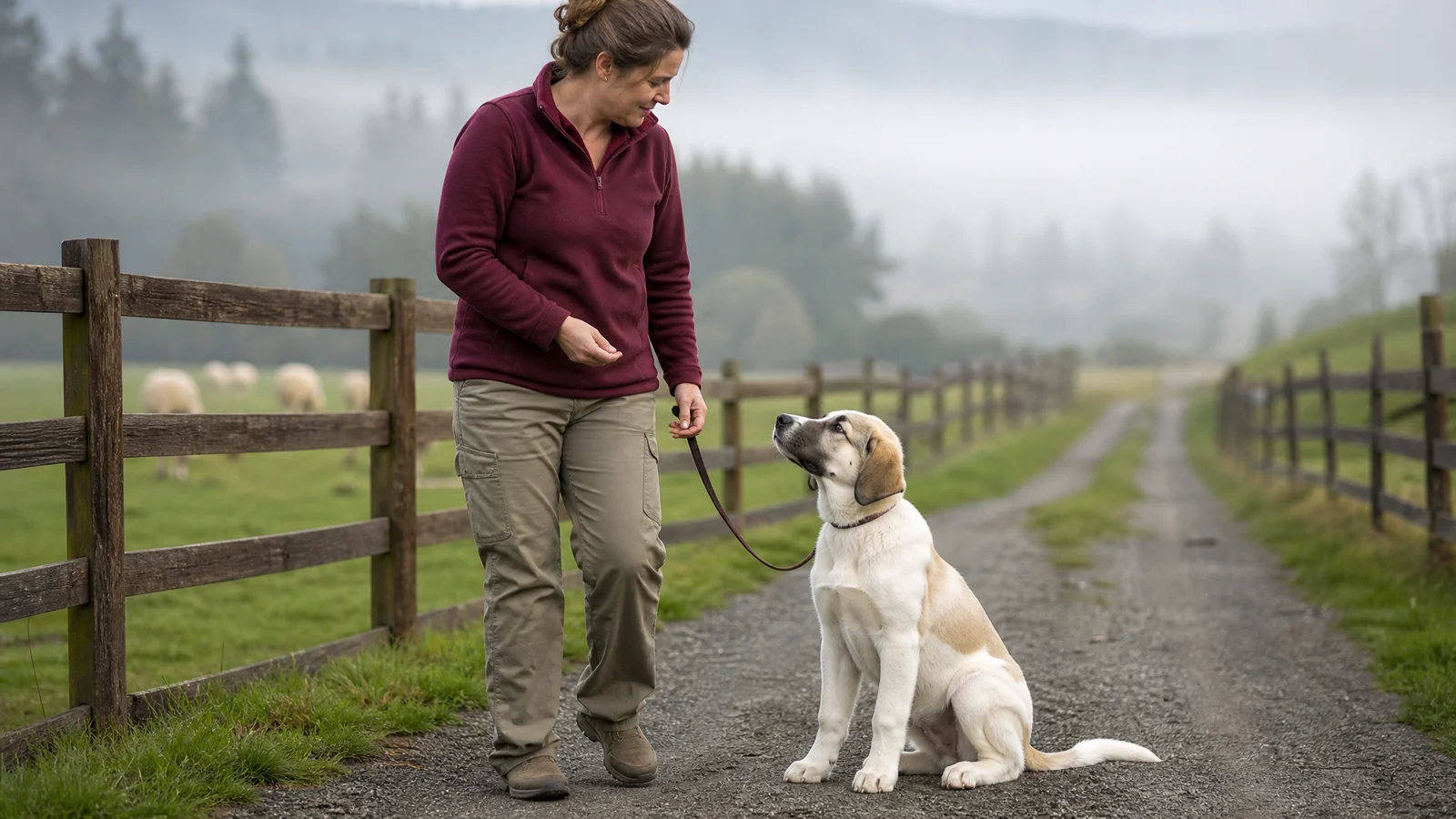
Between four and six months, an Anatolian Shepherd puppy is still learning the way they did before: a request they know, a clear marker, and a reward they like. What changes is mostly the calendar around them, and a calendar is a poor judge of any single puppy. Read on for the one small exchange worth keeping and the signs that tell us to stop.
Two things get overread at this age, the puppy's place on the age chart and the breed's reputation for independence. We keep both as background and let the puppy's response in the moment decide what happens next, which keeps the training reward-based and the puppy willing to take part.
What Four to Six Months Means for an Anatolian Shepherd Puppy
The Texas A&M veterinary school puppy timeline says a puppy's adult teeth should be fully in place by 6 to 7 months of age. That is an all-breed statement, and the word should matters. It describes what is expected across puppies in general, not a date that any Anatolian Shepherd has to meet, and it says nothing about how a particular puppy is learning.
A calendar describes a window and does not assess a puppy. Two puppies of the same age can differ in how quickly they settle, how easily a familiar request lands in a new room, and how long a short exchange stays pleasant. The useful assessment is the puppy in front of us today, taking part or not taking part. If we decide what comes next from that response and not from a birthday, the plan stays honest about what we actually saw.
Questions about teeth or comfort belong at regular veterinary visits, and we leave looking at a puppy's mouth to the vet. If a puppy seems uncomfortable during any activity, we pause it and ask the veterinarian rather than reading the reaction as a training problem.
Keep One Reward-Based Puppy Exchange Small and Familiar
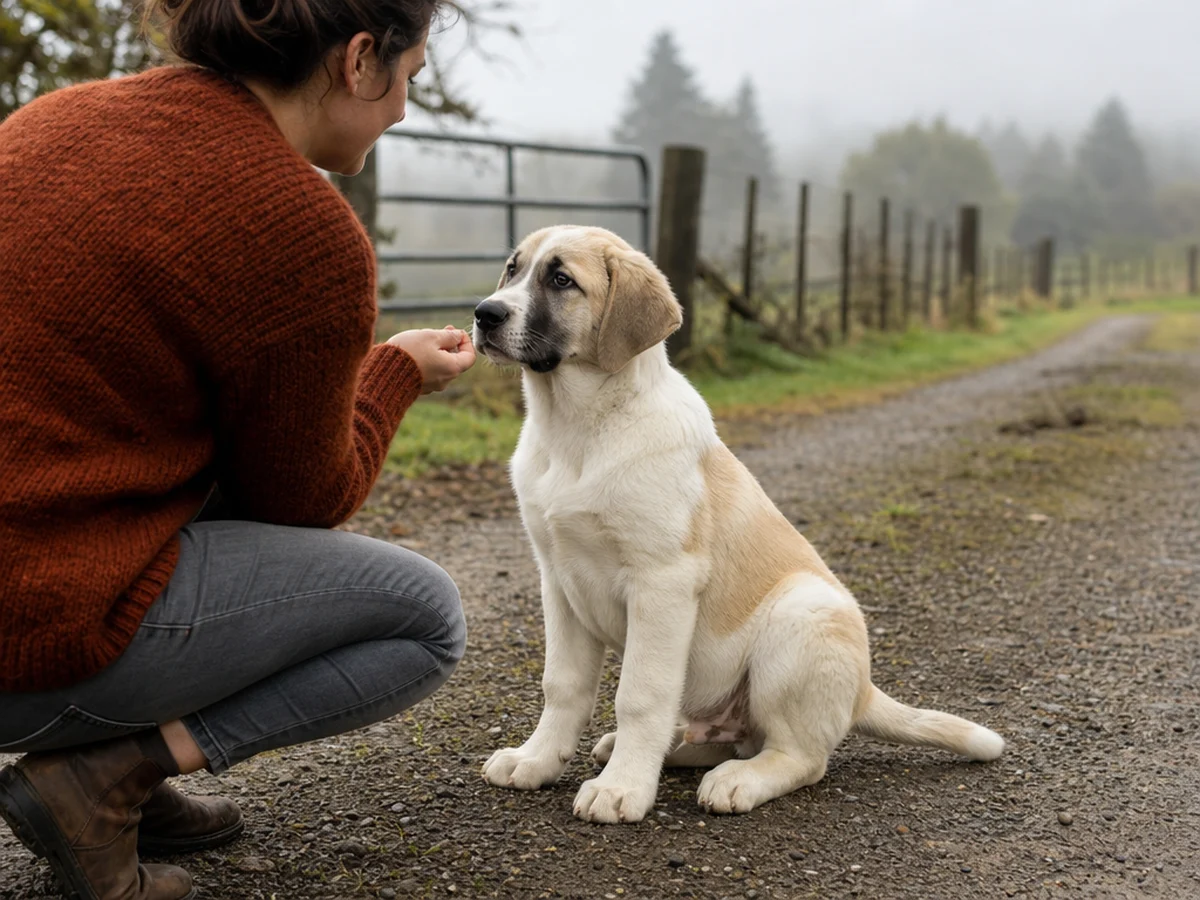
The American Veterinary Society of Animal Behavior describes reward-based training as a cue that asks for a behavior, a marker that identifies it, and a reward that follows. None of the three needs to be elaborate for the exchange to count.
At this stage we can keep all three parts recognizable by choosing a response the puppy already knows, in a place the puppy already knows. Nothing here teaches a new cue. It is a short check-in with something that already works. A small exchange needs only four things:
- A response the puppy already knows, asked for with the cue they already recognize.
- A marker given at the moment the response happens.
- A reward the puppy likes, delivered right after the marker.
- A way out, so that if the puppy does not take part, the exchange simply ends.
The last item matters as much as the first three. A missed response could mean the puppy was distracted, unsure, uncomfortable or simply elsewhere, and a single moment does not say which. We end calmly and decide the next exchange from the puppy, not from the age.
Independence in an Anatolian Shepherd Puppy Is Not a Motive
The United Kennel Club breed page describes the Anatolian Shepherd as naturally independent, very intelligent and tractable. That is a broad portrait of the breed, and it says nothing about how a four-month-old will answer a cue on a given afternoon. It is also not a ranking and not a promise of cue reliability.
When a puppy looks away, pauses or wanders off from an exchange, the behavior alone cannot tell us why. Distraction, uncertainty, discomfort and plain disinterest can look much the same from the outside. Calling it defiance or stubbornness picks one reason without evidence for it, and the label pushes us toward more pressure when a smaller request would serve the puppy better.
Independence is also not a milestone of this stage, and we make no claim that a protection phase begins here. When we hold the breed description loosely, the next decision stays with what the puppy just did.
Quick Questions About This Puppy Stage
A few small details come up once the exchange is running. The answers stay inside what the veterinary sources we reviewed actually say.
Does the marker have to be a clicker? No. AVSAB lists a clicker or a verbal marker, and either one pinpoints the moment the puppy got it right. Pick whichever you can deliver at the right instant, and keep it the same so the puppy hears one signal for one thing.
How many times should we repeat the exchange in a session? None of the veterinary sources we reviewed sets a number, and a target count would quietly turn a voluntary exchange into a performance. A short exchange that ends while the puppy is still willing is the aim. If the puppy leaves after one round, that is a complete session.
Should we check the puppy's mouth to see which teeth have come in? We would not make that a home task. A date range cannot confirm any one puppy's progress, and a handler's look inside the mouth cannot replace a veterinary exam. Mention it at the next regular vet visit and let the vet look.
Letting an Anatolian Shepherd Puppy Choose to Engage
The American Veterinary Medical Association recommends rewarding positive or neutral engagement with praise, play and treats, allowing a pet to withdraw if they seem uncomfortable, and moving at a pace that suits the individual.
Those points give us a plain way to read any exchange or new situation. Engaged is fine, neutral is fine, and leaving is an answer we respect. Pace is individual, so two puppies can move through the same situation at different speeds and both be doing it correctly.
When the Puppy Is Comfortable
A puppy who stays near, takes a reward or returns their attention without being held in place is telling us the situation is workable. We keep it that easy. Neutral counts as well. A puppy who watches calmly from a few steps back is taking part in the only way they need to right now, and not every moment has to become a lesson.
When the Puppy Withdraws
Withdrawal is a request for space. We let the puppy move away, we do not call them back into a greeting, and we do not repeat the approach to see if it works the second time. If a puppy keeps pulling away during ordinary activities, we bring it to the vet or a qualified behavior professional instead of working through it. Space can be as simple as a few steps back or a quieter spot away from the activity, and the puppy decides when they are ready to return.
Where Anatolian Shepherd Puppy Methods Continue
Two guides carry the longer methods. Our Anatolian Shepherd training timeline places this window before and after the other puppy stages, and our Anatolian Shepherd puppy socialization guide covers new people and settings in full. Mouthing and handling each have their own articles.
For the days ahead, the next step can be as plain as one familiar request in an ordinary room, with the option to stop. Some days that will be the exchange above, some days a smaller version, and some days no training at all, and every one of those is fine for a puppy this age.
 Exercise and jobsIndoor Activities and Brain Games for an Anatolian Shepherd
 BehaviorHow to Stop an Anatolian Shepherd Pulling on the Leash
 Training basicsAre Anatolian Shepherds Easy to Train? Smart or Stubborn