
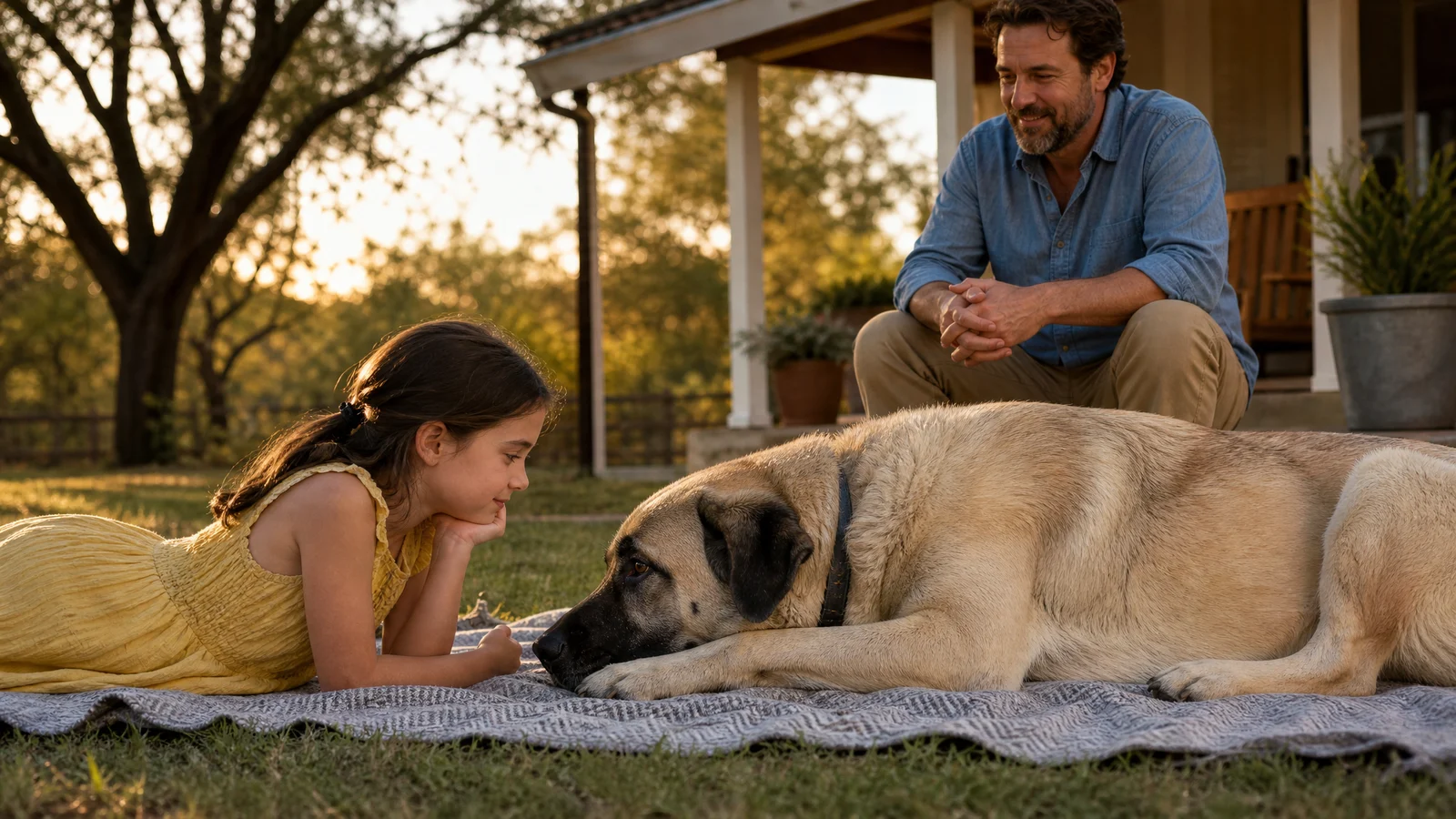
Before an Anatolian Shepherd puppy goes home, the Anatolian Shepherd Dog Club of America says a breeder should ask the buyer a list of questions, and one of them is whether the household has well-behaved children. Others ask whether you are ready to give large amounts of time to socialization and have time to attend training classes.
Answering that question well takes more than one rating, because children and dogs read each other differently and the adults decide how much room each one gets. In this article, we'll go through how children and dogs misread each other, what the breed rating says, the early signals worth reading, the house rules children can learn, and when to bring in professional help. An adult is in the room for every step.
Why Children and an Anatolian Shepherd Misread Each Other
Dogs and children can be great friends, says the RSPCA, and having a dog can help children develop kindness, understanding and respect for living things. It adds that parents need to teach children how to stay safe around dogs, to protect both the child and the dog.
The difficulty is that children tend to treat pet dogs as peers. They hug, cuddle and scold, and they show affection through very close facial contact, often kissing. Much of that is the opposite of dog social behavior, and a dog may find it threatening. Toddlers add clumsiness, such as standing on feet or tugging ears, hair and tails.
From the dog's side, children cry, yell, shriek, crawl and run about unpredictably, and the RSPCA says dogs find it hard to tell them when they want to be left alone. For these reasons young children are far more likely to be bitten than any other group.
Bite Risk Starts at Home
People are also more likely to be bitten by their own family's dog than by an unfamiliar one, which puts children in the highest-risk group for the dog at home. The first of the six rules in that guidance is to stay with your children around dogs and never leave a child alone in a room with a dog, even your own.
None of this is a breed claim. It describes children and dogs in general, so the supervision it calls for applies to every household. Learning to read a dog's body language is the usual way to narrow the gap, and the signals section below takes that step by step. The exposure plan itself, meaning how a dog meets children, neighbors and visitors, lives in our Anatolian Shepherd socialization guide.
Times a Child Leaves the Dog Alone
The RSPCA's golden rules tell children not to approach a dog who is eating, playing with a toy, sleeping, unwell, injured, tired, blind or deaf. They also say children should not approach dogs they do not know, such as in the park, and that a cozy spot in a quiet room gives the dog a place of their own to be left alone.
Its list of ways children should not treat dogs adds hugging, since most dogs dislike it, putting a face up to the dog's face, climbing on them, and screaming or shouting around them. An inside voice is the rule.
How an Anatolian Shepherd Scores Around Children
On the breed page, the American Kennel Club rates the Anatolian Shepherd Dog 3 of 5 for Good With Young Children, where 1 means Not Recommended, 3 means With Supervision and 5 means Good With Children. The page describes the trait as tolerance and patience with children's behavior plus overall family-friendly nature, and adds that dogs should always be supervised around young children, or children of any age with little exposure to dogs.
| Trait | Rating | Scale label | Ends of the scale |
|---|---|---|---|
| Good With Young Children | 3 of 5 | With Supervision | Not Recommended to Good With Children |
| Affectionate With Family | 1 of 5 | Independent | Independent to Lovey-Dovey |
| Openness To Strangers | 1 of 5 | Reserved | Reserved to Everyone Is My Best Friend |
| Playfulness Level | 3 of 5 | Moderate | Only When You Want To Play to Non-Stop |
The table lists that rating beside the other ratings that bear most on life with children. The official breed standard adds a note on handling: responsiveness with animation is not characteristic of the breed, and overhandling would be discouraged.
We read the supervision wording as the part of this rating that stays within a household's control. The breed page gives no figure for how any one Anatolian Shepherd behaves with any one child, at any age or in any home, so no number here promises a good or a bad outcome.
Early Signals to Read When Children Are Near the Dog
Dogs usually give a lot of warning well before a growl, according to PDSA. Its ladder of communication treats stress as a series of steps. When early signals go unheard, a dog may climb to more obvious ones, up to growling, snapping and biting, and a dog whose mild signals were ignored before may skip steps. Not every dog shows every step.
- Yawning, blinking or licking the nose can be the first sign of discomfort, since yawns are more often a way to relieve tension in the jaw than a sign of tiredness.
- Looking away, turning the whole body away, or sitting down while pawing someone away is a way of asking for space.
- Creeping is a more expressive way of showing worry or wanting space, and the whites of the eyes may show, sometimes with a raised paw or lip licking.
- Freezing means the dog is stressed enough that a fight, flight or freeze response is starting, and they may stay very still until the perceived threat has gone away.
- A growl is a clear and loud sign that the dog is distressed or afraid and asking for space after earlier steps were ignored.
What to Do at the First Signal
The lower signs are really common, and once you start looking for them you will see them often. The sooner an adult picks up the early steps and stops whatever the dog finds stressful, the less likely the dog is to move up the ladder, which is why we end contact at the first one.
PDSA also says never to punish a growl, because you are more likely to train the warning out and the dog may then jump from a lower step straight to a snap or a bite. Let the dog walk away too, since blocking their escape can send them up the ladder.
What Children Learn Before Sharing Space With the Dog
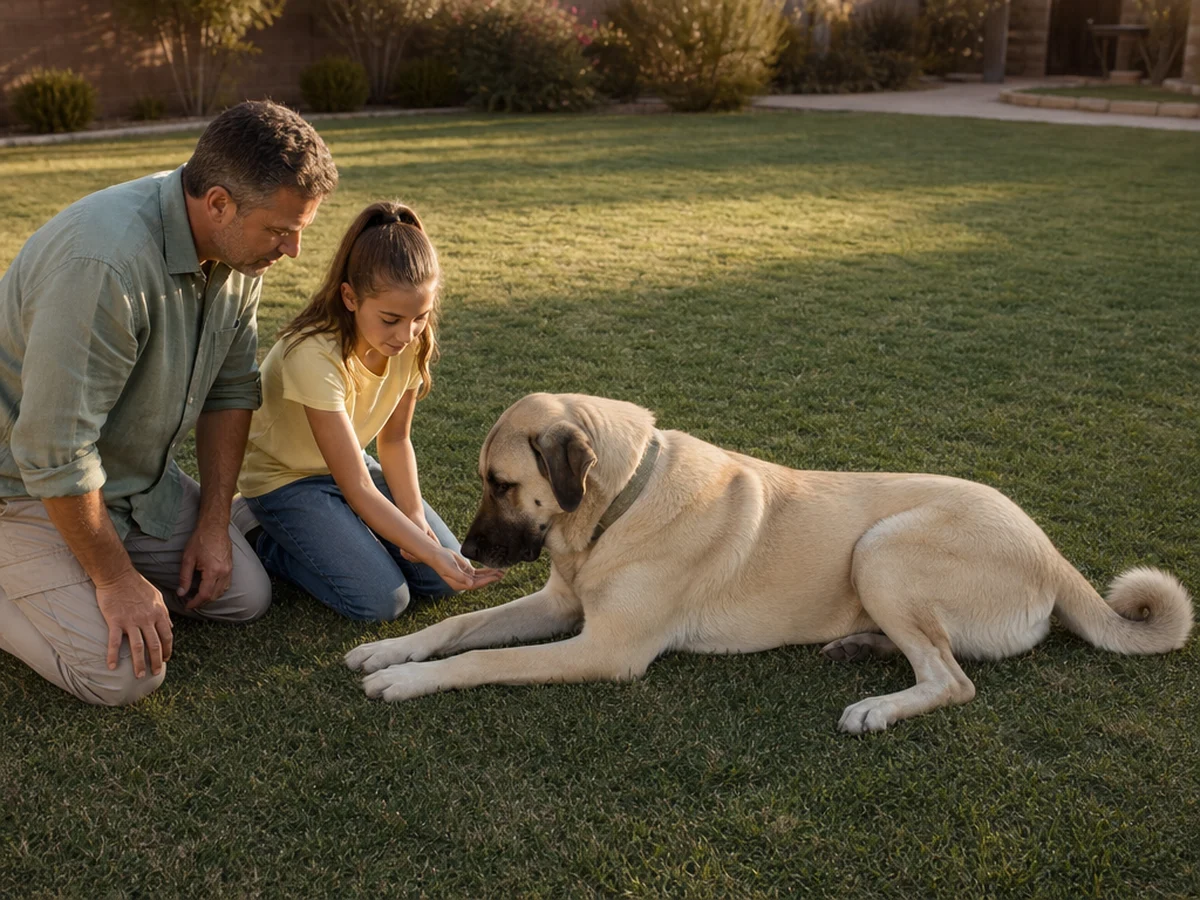
As children grow, the ASPCA advises teaching them to respect the dog's body, safe zones and belongings, and supervising every interaction so an adult can guide how the child communicates and plays. The three parts below cover contact, the dog's way out, and the dog's things.
Gentle Contact and Play
We start by showing a child what gentle, enjoyable petting looks like, stroking and scratching the dog's favorite spots. Hitting, kicking, pinching, riding, teasing and intentionally scaring a dog are not okay, and a child can be told so in plain words.
Structured games give a child a job that does not involve grabbing. Fetch and hide-and-seek count, and training games, trick training and clicker training are fun for children and dogs alike. A class with an instructor who welcomes children lets a child learn to cue the dog.
When the child says a cue and the dog follows it, an adult helps the child praise and hand over a treat. If the dog hesitates, the adult repeats the cue, so the dog learns that the child's requests are worth answering.
Pairing helps too. If a dog seems worried about a child, feed the dog their meal while the child eats, bring the dog along on the child's stroller walks, and do not isolate the dog elsewhere in the house during play. Find ways for the dog to take part in the games.
A Retreat the Dog Can Choose
Many dogs do not realize they can move away from a child when they feel tired or nervous, and a dog who does not know retreating is an option may resort to growling, snapping or biting. So we teach a reward-based go away cue. In a calm, cheerful tone, say the cue, point to where the dog should go, and reward them when they move.
The room matters too. Minimizing furniture, and pulling what remains a couple of feet from the walls, creates escape routes so the dog is not cornered behind a sofa or under a table.
A safe zone is a bed, rug or mat in a room where the family spends its time. Stand beside it, say "Go to your spot," toss a treat onto it and praise the dog as they eat, then stand a step or two farther away in later sessions. Our Anatolian Shepherd settling guide covers mat practice in full.
Until the dog has learned these skills, an adult steps in and removes the child whenever the dog starts to look nervous, before the dog feels any need to defend themselves. Never force a dog to interact with a child, and let the dog approach on their own.
Food, Bones and Toys Within Reach
Babies and young children do not know that dogs sometimes get upset when people approach food, chew bones or toys, and the ASPCA recommends resource guarding prevention even for a dog who has never guarded. Our Anatolian Shepherd guarding guide teaches the method, so this page covers only the arrangements around a child.
Some dogs show aggression toward a new baby because they have not been well socialized to children and find them foreign and frightening, and others guard food, toys or chew bones. Young children also have trouble recognizing a dog's warnings, and some find growling amusing.
If a dog shows aggressive behavior around a baby or young child, or you think they might, keep the dog and the child apart at all times and contact an animal behavior expert at once. Punishment can backfire, because it teaches the dog that bad things happen when the child is present, which gives them another reason to dislike the child.
Professional Help for an Anatolian Shepherd and Children
The American College of Veterinary Behaviorists says that because the potential consequences are so serious, you should get professional help from a veterinary behaviorist for any animal displaying aggressive behaviors. It adds that aggression can be a sign of an underlying physical problem, and that if it is mismanaged or help is not sought early, it often worsens.
Veterinary behaviorists are licensed veterinarians with extra behavior-specific training, including at least three years of supervised case work and a board examination. They take detailed behavioral and medical histories and are trained to work out whether a medical component is involved.
Behavioral problems are complex and can have many causes, and the college notes that change takes a concerted effort under the guidance of a trained professional. Veterinarians may only call themselves behaviorists if they have achieved board certification, and the college says there are no such restrictions on trainers or others, who are not required to have any education to use the word.
In practice, keep the dog and child apart while help is arranged, then work from the professional's plan for your household. Regular vet visits stay on the calendar, and our Anatolian Shepherd vet handling guide covers preparing the dog for them.
Daily Life With an Anatolian Shepherd and Children
Life with children and a dog is mostly small decisions an adult makes before anything happens: whether the child and the dog share a room, whether the dog can see a way out, and whether a chew or a bowl is within a child's reach.
A page like this one cannot see your household, so a worry about one particular child and one particular dog belongs with a professional who can. Until then, an adult stays in the room.
 Puppy trainingAnatolian Shepherd Puppy at 3 to 4 Months: Teething and Mouthing
 Puppy trainingAnatolian Shepherd Puppy: What to Expect and How to Start Training
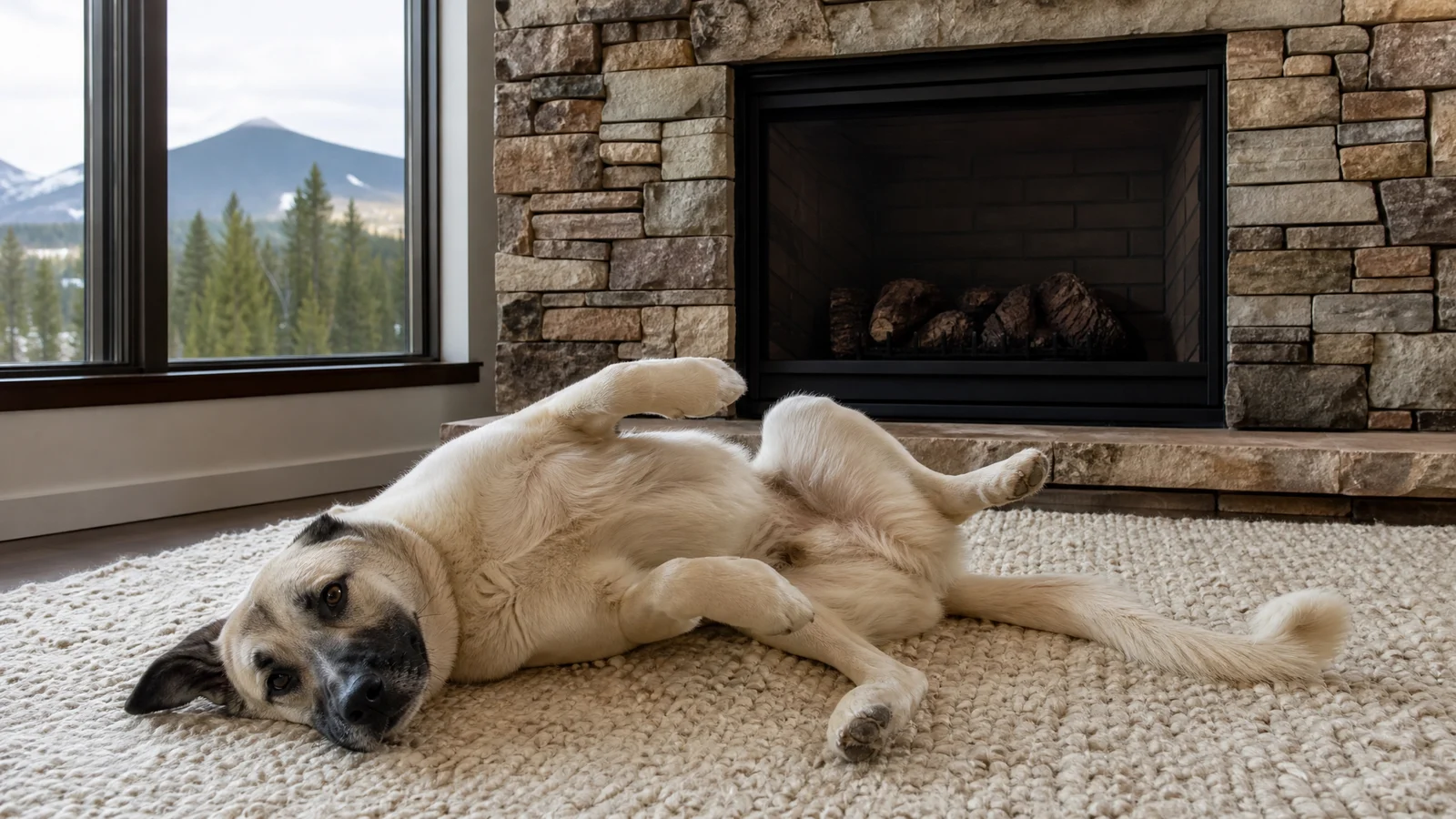 Exercise and jobsHow to Teach an Anatolian Shepherd to Roll Over