
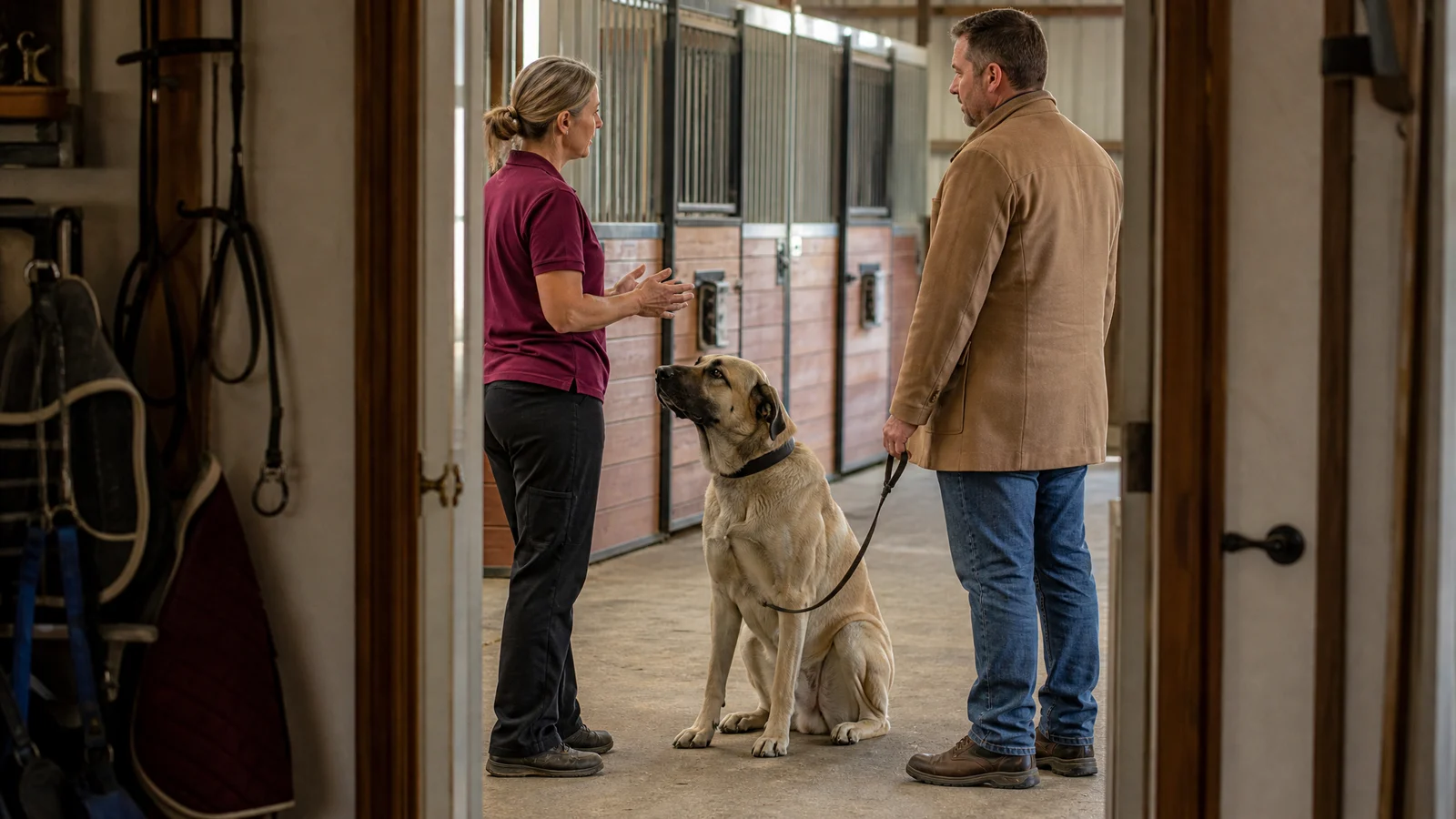
Choose an Anatolian Shepherd trainer by verifying what a credential means, asking how the dog will be taught and matching the professional's scope to the actual need. A breed-specialist label alone does not document a qualification or guarantee a result.
Look for clear answers about methods, relevant experience, progress decisions and referral boundaries. A useful conversation should tell you what the professional will do when the dog participates, when the dog struggles and when the concern belongs with a veterinarian.
In this guide, we will examine credentials as evidence, test training promises against concrete methods, separate skill lessons from behavior assessment and identify the unanswered questions that should stop a rushed choice.
Credential Evidence for an Anatolian Shepherd Trainer
Read every credential as a specific claim that can be checked. The Certification Council for Professional Dog Trainers describes dog training as an unregulated industry in the guide's context. The council says one named credential requires an exam plus at least 300 hours of training experience. Attribute those details to the issuing organization rather than treating them as universal law.
A credential may show that stated requirements were met, but it does not promise compatibility with your dog, a particular teaching style or a deadline. Verify the current issuing body, the status of the credential and the experience relevant to the problem you are bringing.
| Claim You See | What to Verify | What Remains Open |
|---|---|---|
| A named certification | Issuing body, current status and published requirements | Methods, relevant case experience and fit with this dog |
| Behaviorist title | Education, professional role and whether the title is board-certified veterinary use | Exact scope, collaboration and who makes medical decisions |
| Breed specialist | What experience the claim refers to and how it is documented | Whether the proposed method suits this dog's need |
| Guaranteed result | Written explanation of the outcome and conditions | Why uncertainty and the dog's response are being omitted |
Credential Records and Limits
Save the credential name, issuing body and date you checked it so the household can verify the same claim. If a status cannot be confirmed, record that limitation instead of guessing. Verification answers one question about the claim and leaves method, scope and relevant experience to the rest of the conversation. Save the published requirements with the note so a later review checks the same claim rather than relying on memory.
\n\nThe American College of Veterinary Behaviorists explains that the veterinary behaviorist title is tied to ACVB board certification, while trainers and other people may use behavior language without the same restriction. Use that distinction to ask precise questions. Do not infer local licensing rules or qualifications that the person has not documented.
Transparent Methods Before Training Promises
A promised outcome does not explain the teaching process. Ask what the first session would look like, which behaviors the trainer will observe, how rewards will be used and what would cause the plan to become easier. The answer should describe actions rather than rely on slogans.
Be cautious when the timeline is presented as certain before the professional has met the dog or gathered a useful history. Learning can change with health, environment, prior experience and the skill being taught. A fixed promise may hide those variables instead of planning for them.
Ask how progress will be recorded. Observable measures might include whether the dog can participate at a chosen distance, follow a familiar cue in a defined setting or recover after a manageable exercise. Avoid a score that labels the dog without describing the conditions.
Also ask what happens when the plan is not working. A transparent professional should be able to discuss changing distance, duration, environment or task difficulty. Difficulty is information about the setup, not permission to add fear, pain or intimidation.
Questions for an Anatolian Shepherd Trainer
Describe the need before asking whether someone has breed experience. The United Kennel Club standard describes the breed as naturally independent, intelligent and tractable. That is broad context, not proof that one method fits every Anatolian Shepherd or that coercion is necessary.
The Anatolian Shepherd temperament guide owns the broader breed profile. Here, use breed context to sharpen questions about communication, environment and realistic practice. Do not let it replace a description of the individual dog's behavior.
Use this general interview sequence before agreeing to a lesson or program. Each step should produce an answer the household can record and check.
- Describe the actual need. Name the behavior, setting, first observable change and current management without assigning a motive.
- Ask for the method. Request a plain-language explanation of what the trainer will mark, reward, change and stop.
- Ask about relevant experience. Focus on the same kind of skill or concern rather than a broad breed label.
- Verify the credential. Check the issuing body and current status instead of relying on initials in an advertisement.
Take notes after the conversation instead of deciding from confidence or presentation. Compare whether the answers were specific, humane and within the person's stated scope. This article does not know which professionals are available in your area and does not operate a matching service.
Matching Training Help to the Actual Need
Different needs call for different professional roles. Teaching a defined action is not the same job as assessing a serious behavior change, and neither job replaces ordinary veterinary care. Begin with what needs to change and what risks are present.
The training overview for this site covers the household's broader routine. Use the separate Anatolian Shepherd training overview to distinguish everyday learning from this professional-selection decision.
A Skill to Teach
A skill lesson might cover a clearly defined action such as going to a mat, walking with manageable leash tension or participating in handling. Ask how the response will be taught in a low-pressure setting, how difficulty will increase and how the household will practice between sessions.
Relevant experience still matters, but it should connect to the task. A trainer who can explain reward timing, setup changes and transfer to the household provides more useful information than a person who only repeats that they understand the breed.
A Behavior Problem Requiring Assessment
The DACVB guidance distinguishes teaching actions on cue from addressing the root of a behavior problem. That boundary matters when fear, aggression, separation distress or a sudden change is involved. A checklist cannot determine the cause, and ordinary obedience practice may not address it.
Ask who will assess health, risk and behavior history, and how the trainer works within that plan. Do not stage a reaction to prove its severity or gather a dramatic video. Safe management and accurate description come before a demonstration.
Clinical and Training Roles
Clinical support and training can have different responsibilities in one plan. The AVSAB humane-training statement says serious fear, aggression, separation anxiety, noise phobia or compulsive concerns should be evaluated by a veterinarian. It also supports reward-based training.
A trainer can help the household teach skills and carry out a humane behavior plan within their competence. The veterinarian evaluates health and makes medical decisions. Collaboration does not imply that every trainer is a clinician or that a specialist is locally available.
Keep Medical Decisions With the Veterinarian
This article does not make individual care decisions. Arrange regular veterinary visits, and seek an individual veterinary evaluation for sudden changes or serious behavior concerns before asking a trainer to increase difficulty.
Ask how records will move between professionals when collaboration is appropriate. Useful notes describe the setting, observable behavior, management and recovery. They should not turn a trainer's guess into a medical conclusion.
What Happens When an Anatolian Shepherd Struggles
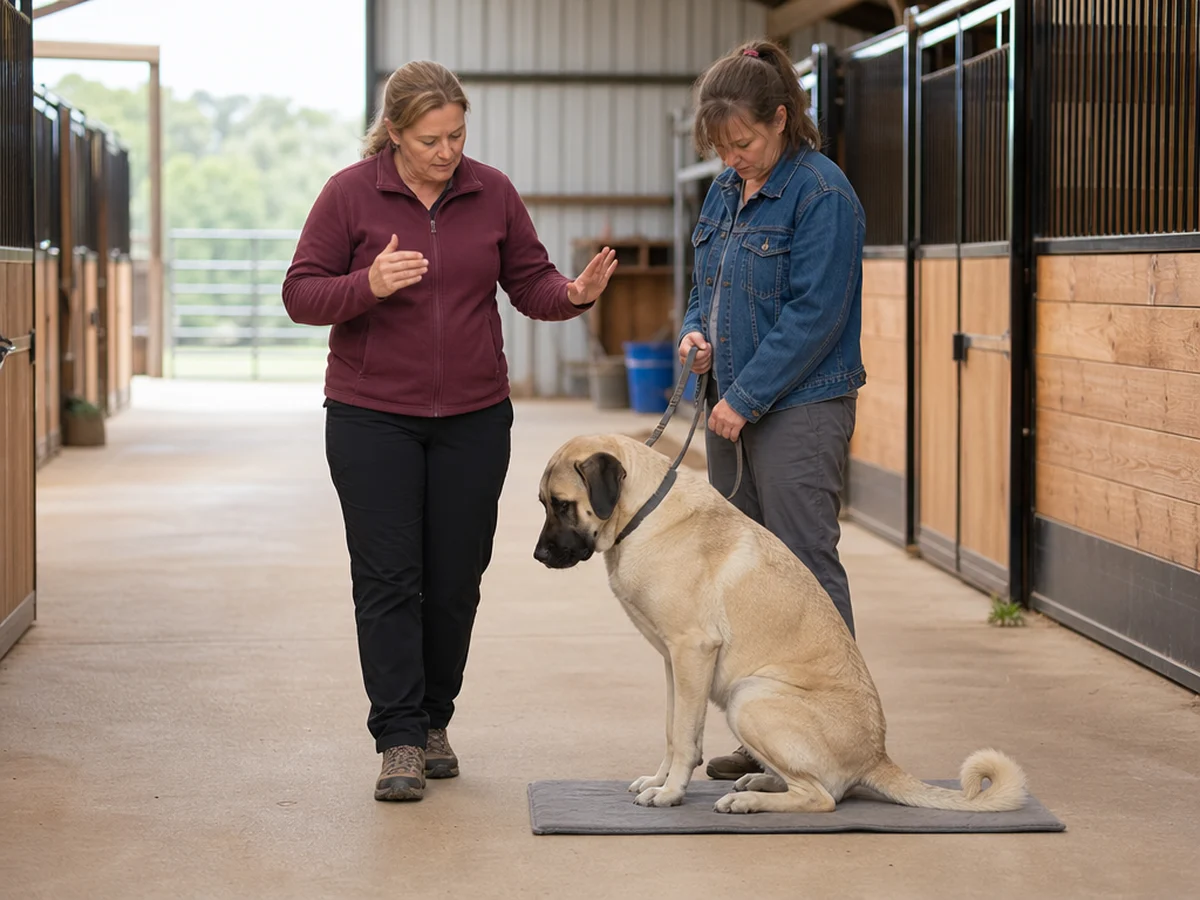
Ask this question before a difficult session occurs. A reward-based answer should include making the task easier, changing the environment, restoring distance or ending the attempt. The plan should protect participation rather than punish the dog for losing it.
Request a concrete example that does not require provoking the dog. If a professional cannot explain how they will respond without adding fear, pain or intimidation, the method remains unclear. An acronym or specialist label does not remove that concern.
Record the items that are still unanswered after the conversation. The note should identify the missing evidence or explanation rather than assign a score to the professional.
- Unclear method. The professional names an outcome but cannot describe the teaching setup or reward.
- Unverified credential. The issuing body, current status or stated requirements cannot be confirmed.
- Unsupported guarantee. The promise ignores health, environment, history or the dog's response.
- Missing relevant experience. The answer relies on a breed label without connecting experience to the actual need.
One unanswered item does not create an automatic score, but it does identify what must be clarified. Delay the choice when the missing answer affects safety, humane methods or professional scope.
Questions After Assessing a Trainer
The body has covered credential evidence, method transparency, relevant experience, professional scope and the response to difficulty. These remaining questions help the household prepare and monitor the working relationship without inventing provider access or a guaranteed result.
What should the household bring to the first trainer conversation? Bring a short description of the behavior or skill, the setting where it occurs, current management and any recent change. Include what the dog can already do comfortably. Keep the record factual so the professional can ask useful follow-up questions.
Can a trainer observe the dog without provoking the problem? Yes, the conversation should begin with history and ordinary observation rather than a forced demonstration. Ask how safety and distance will be preserved. Decline a setup that requires the dog to lose control merely to prove the concern exists.
Does relevant experience have to be breed-specific? Not always. Experience with the same kind of skill, environment or behavior concern may be more informative than a broad breed label. Ask the professional to connect their experience to the exact need and explain what remains unfamiliar.
Reviewing the Working Relationship
Should household members attend training conversations? The people who will carry out the plan need access to the instructions and a chance to ask questions. Attendance can vary, but the household should agree on cues, management and stop conditions. A plan understood by only one unavailable person is difficult to use consistently.
What if the method explanation changes after work begins? Pause and ask what new observation caused the change, what the new setup involves and how it remains humane. A plan can adapt without becoming secretive. Do not continue an unfamiliar procedure merely because time has already been invested.
Does every difficult behavior belong in a group class? No. Ask whether the class environment allows enough space, individual support and a safe exit for this dog. If the format does not match the concern, request a different scope instead of using the group as a test.
How can progress be reviewed without a guaranteed deadline? Compare observable responses under defined conditions, such as participation at a chosen distance or recovery after an easy exercise. Change one factor at a time and record the result. Progress can be discussed honestly without promising when every setting will become easy.
Can the choice wait while a credential is verified? Yes. Verification is part of the selection process, and urgency does not make an unclear claim reliable. Keep current safety management in place while you check the issuing body and decide whether the remaining answers are specific enough.
Transparent Training Help Without a Breed Promise
Choose help that can explain its credentials, methods, relevant experience and limits in plain language. The right scope matters more than a confident breed-specific promise, and a referral boundary can be evidence of responsible practice rather than a weakness.
This site does not claim staff qualifications, local trainer availability, testimonials or a live matching endpoint. Verify current information yourself, keep medical decisions with the veterinarian and let transparent humane teaching be the standard for the next conversation.
 Training basicsAre Anatolian Shepherds Good With Kids?
 Puppy trainingAnatolian Shepherd Puppy at 3 to 4 Months: Teething and Mouthing
 Puppy trainingAnatolian Shepherd Puppy: What to Expect and How to Start Training