
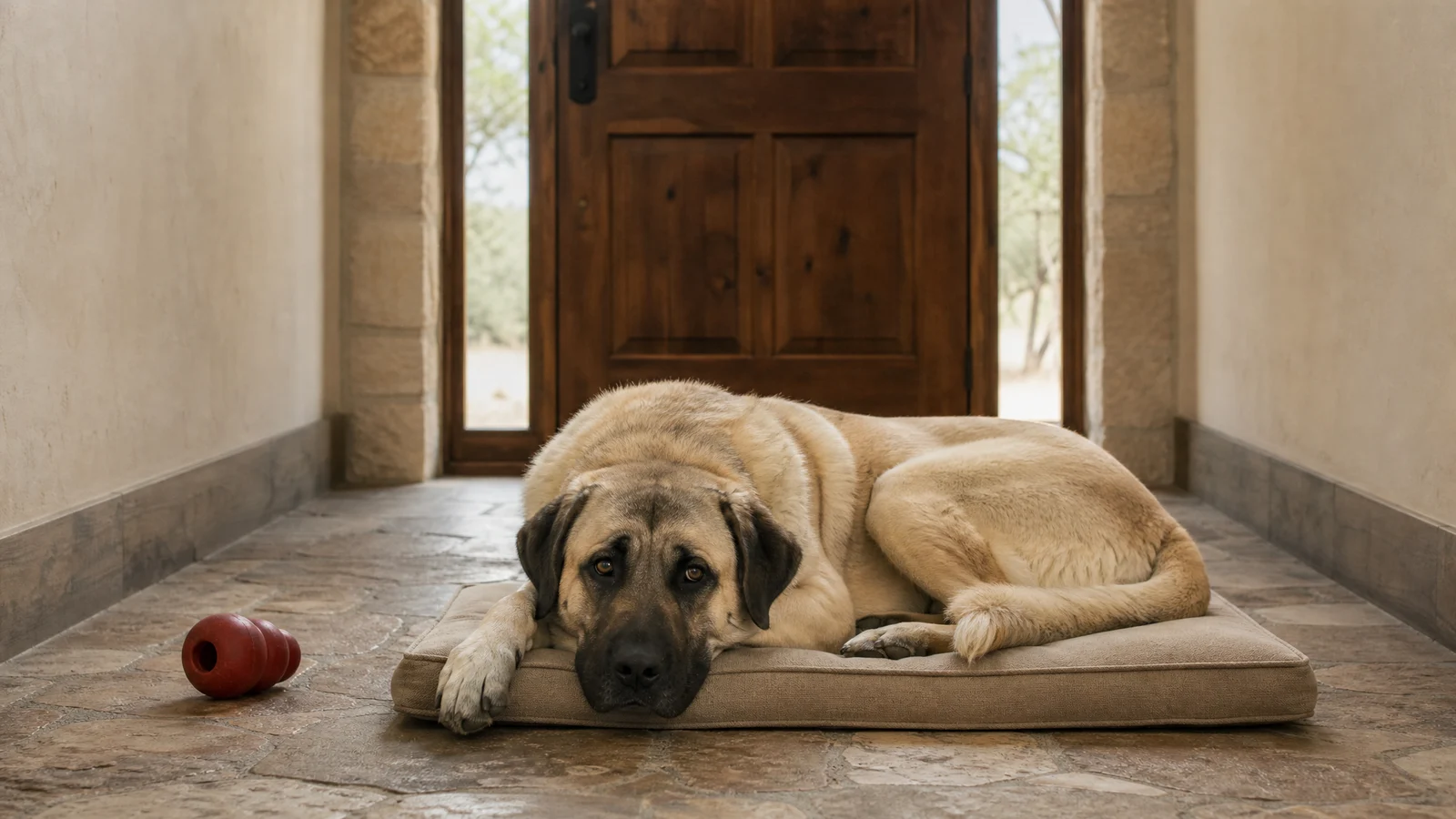
A chewed door frame, or a howl that begins minutes after the car leaves, is easy to read as spite. The ASPCA describes these behaviors as distress responses rather than disobedience, and the way forward is gradual practice at being alone, not a talk at the door when you get home. Done well, the practice also gives you a dog who rests instead of rehearsing worry.
Anatolian Shepherds add a wrinkle. A vigilant breed who sounds off at passersby can look like a dog in distress, and a dog in real distress can be mistaken for a vigilant one. Below, you'll find how to tell the two apart, why a vet visit comes before any practice, and how doors, keys and food toys build comfortable time alone.
Is It Anatolian Shepherd Separation Anxiety or Something Else?
Damage and noise while you are out do not prove anxiety. The tell is timing. Separation anxiety shows up when the dog is alone or while you get ready to leave, with signs such as drooling or visible worry as the keys come out. Soiling, barking or chewing that also happens with people at home points somewhere else. Several lookalikes deserve a fair look before you settle on a label.
Barking is the lookalike to sort out first with this breed. The American Kennel Club breed page rates watchdog and protective nature at the top of its scale, Vigilant, and barking only Occasional. Barking at trucks, neighbors and passersby is an alert and tends to continue when family is home, while barking or howling that starts only once you are gone fits distress far better. Our Anatolian Shepherd barking guide covers the guardian voice itself.
- Boredom produces mischief while you are gone, but the dog usually does not look anxious, only like someone searching for something to do.
- Juvenile destruction means chewing or digging that happens with the family at home as well as away.
- Barking at unfamiliar sights and sounds usually continues when people are home, which separates it from distress tied to being alone.
- Incomplete house training causes the occasional accident whether or not anyone is in the house.
- Urine marking and submissive or excitement urination show up as small amounts on vertical surfaces or as puddles during greetings and play.
Ask Your Vet Before Starting Separation Anxiety Work
Behavior work comes second. The same guidance that describes the practice below asks owners to see their veterinarian first, because house soiling can come from medical problems, and some medications can cause frequent urination. A dog who is leaking urine without seeming to notice is a medical question, not a training one.
The RSPCA makes the same point more broadly: health issues can cause or worsen behavior when a dog is left alone. Regular veterinary visits give you a baseline and a professional who already knows your dog, which matters if the picture gets complicated later.
Whether medication has any place in a plan is a decision for your veterinarian or a veterinary behaviorist, never for an article, and the practice in this guide works the same way whatever they decide.
This is general information, not medical advice. Ask your veterinarian about any health concern, any medication your dog already takes and any decision about medication for anxiety.
Why Anatolian Shepherd Separation Anxiety Starts Before You Leave
Some dogs who struggle with absences begin to unravel while you are still in the house. They pace, pant or whine as shoes go on, a coat comes off the hook or a bag and car keys are picked up. For these dogs, even a few seconds out the door can set off intense distress, because the routine has become a warning.
The fix is to take the meaning out of the routine. Pick up the keys and sit down at the kitchen table. Put on your coat and watch television. Do the pieces in different orders, many times a day, without leaving. The same guidance cautions that your dog has years of learning behind those cues, so expect many weeks of practice departures before the cues lose their punch.
If your dog shows no sign of worry while you get ready, skip this step and move straight to the practice below. If they do, plan on this work running alongside everything else.
Out-of-Sight Practice Behind Inside Doors
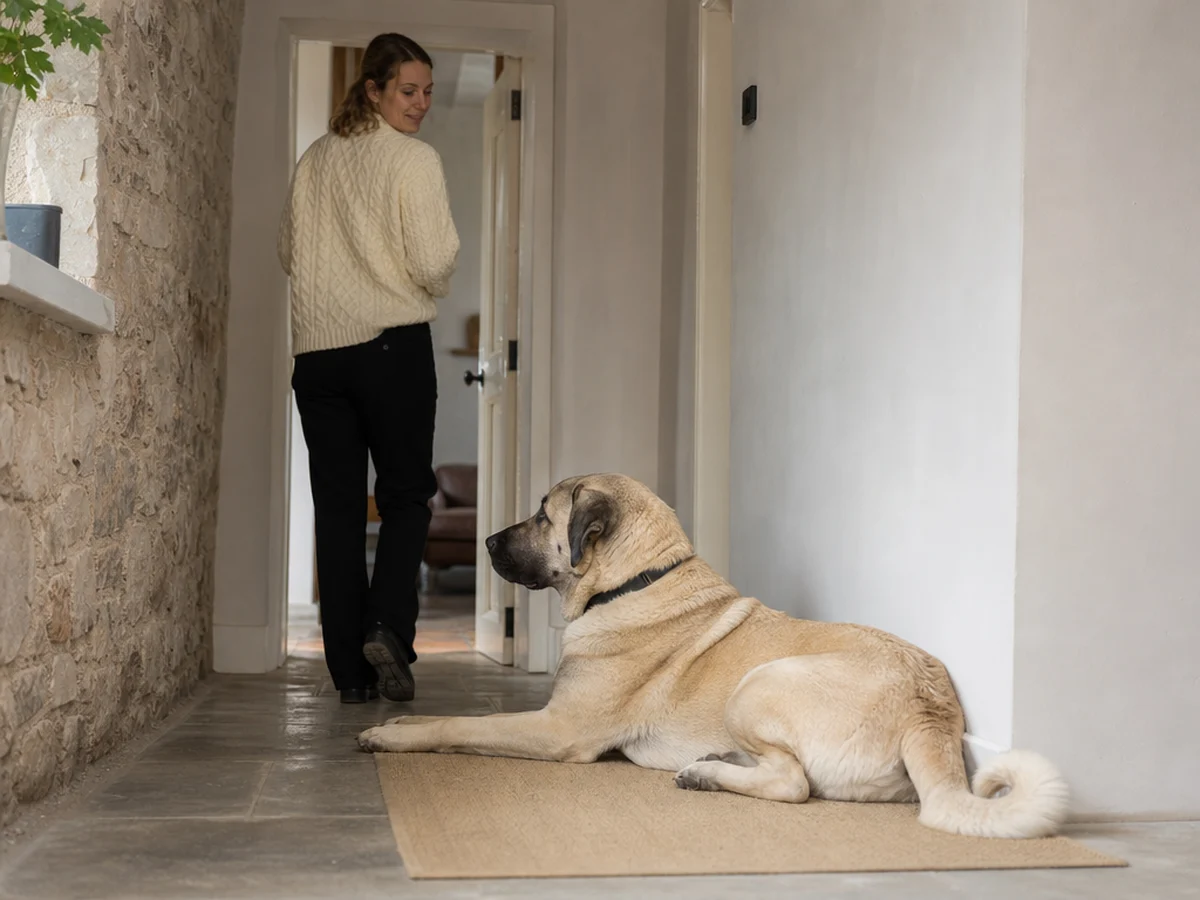
The main rule of graduated practice is to keep each absence shorter than the time it takes your dog to become upset. That means beginning far below real departures, with a reward-based stay at an inside door. For a large, powerful dog, choose a door you can actually close or a barrier that is truly sturdy, so the exercise stays about learning and not about escape.
The Door Ladder
Think of the ladder as a progression of doors instead of a progression of clock time. Each rung should feel boring to your dog before you climb to the next.
- Ask for a sit or down and a stay beside an inside door, such as the bathroom, then step to the other side, come back and reward.
- Lengthen the wait on the far side a little at a time while you stay out of sight, and fold in a few departure cues such as the coat or purse while the dog stays.
- Repeat the same stay at a bedroom door, and later at an exit door, starting with the back door if the front door is the usual way out.
- When exit-door stays feel easy, add real absences of 1 to 2 seconds, then lengthen them slowly.
Food Toys and Waiting Between Absences
Once absences reach 5 to 10 seconds, hand your dog a stuffed food toy just before you step out. It builds a pleasant association with being alone, and it works as a safety signal that this is one of the easy separations.
Wait a few minutes between absences, and make sure your dog is completely relaxed before you leave again. Going out while they are still excited about your last return means the next absence starts with arousal, which can make it harder to tolerate. Keep exits and returns calm and quiet, so there is less contrast between the times you are there and the times you are gone.
Most anxious responses happen in the first 40 minutes alone, so expect to spend a long stretch of practice approaching that mark. Over weeks, the increases are only a few seconds per session, or every couple of sessions, depending on how your dog copes. No standard timeline exists.
Reading Stress and Backing Up
Owners tend to rush, and an absence that runs too long provokes the anxiety you are trying to prevent. Watch for dilated pupils, panting, yawning, salivating, trembling, pacing and an exuberant greeting. Any of these means the last step was too big.
When you see them, shorten absences to a length where your dog relaxes again and start over from there, progressing more slowly. A step back is part of the plan, not a failure of it. Slow sessions that end calm teach more than quick ones that end in a scramble, and nothing in the sources suggests an Anatolian Shepherd needs a different pace than the dog's own comfort sets.
Anatolian Shepherd Time Alone Between Practice Sessions
Practice only works if real absences stop undoing it. During training, your dog should not be left alone beyond the sessions themselves, because a full-strength episode teaches the opposite of what you are building. Gaps in your schedule need cover.
- Take your dog to work with you, if that is possible and welcome.
- Arrange for a family member, friend or sitter to stay in your home, since most dogs with this problem are fine as long as someone is with them, and that someone does not have to be you.
- Use a sitter's house or a daycare if your dog already handles new places and new people well.
Exercise and mental work support the plan without replacing it. The ASPCA suggests at least 30 minutes of aerobic activity daily, ideally right before you leave, along with food puzzle toys and chews whenever you go. The breed's own ratings put energy and mental stimulation needs at moderate, and our Anatolian Shepherd exercise guide helps you fit that into a normal day.
Crate, Gate or Open Room
Crates divide dogs with this problem. A crate becomes a safe place for some dogs and adds stress for others, with heavy panting, excessive drooling, frantic escape attempts or persistent howling as the warning signs. Humane World for Animals adds that an anxious dog may soil, howl or injure themselves in a crate.
PDSA says crates should not be used to manage separation anxiety without professional guidance. A safe room with windows, toys and an item that smells like you is the usual alternative. Choose a gate or door that can handle a large dog, and use our Anatolian Shepherd crate guide for the equipment itself.
Hellos and Goodbyes
Keep departures dull. Give a pat, say goodbye and go. When you come home, say hello and then give no more attention until your dog is relaxed. If excitement runs high, ask for something already known, such as sit, down or shake. A predictable schedule helps too, leaving and returning at similar times so that coming back becomes something your dog can count on.
A settled place helps all of this. Our Anatolian Shepherd settling guide shows how to build a spot where your dog relaxes while you are home, which gives practice sessions something familiar to return to.
What to Do When Separation Anxiety Behavior Appears Anyway
You will come home to a mess at some point, even with good practice. Resist the urge to scold or punish. Anxious behavior is not disobedience or spite, and punishment can make a dog who is already upset far worse.
Treat the mess as information instead of an insult. Ask what changed: a longer absence than planned, a skipped session, an unusual noise, a new schedule. Then go back to the last step that felt easy and rebuild from there, with cover in place for the hours you cannot practice.
Progress runs on the dog's pace, not ours. The ASPCA says a program with several sessions on weekends and two a day during the work week can be done within a few weeks, while Humane World notes that some dogs need months. Neither claim is a promise for an Anatolian Shepherd, and both are good reasons not to hurry.
When a Professional Should Lead
Moderate and severe cases call for more than an article. Desensitization and counterconditioning are complex, and the process must change with your dog's reactions. A Certified Applied Animal Behaviorist, a board-certified veterinary behaviorist or a qualified Certified Professional Dog Trainer can design and adjust the plan with you, and your veterinarian can coordinate if medication ever becomes part of it.
Anatolian Shepherd Separation Anxiety Can Return With Life Changes
A schedule change, a move, a change of guardian or family, a family member leaving or an owner returning to work or school after a long stretch at home can all trigger the problem or bring it back after a good run. The breed's adaptability rating is Moderate, so a big routine change deserves a plan, not a hope.
Before the change arrives, drop back to short, easy absences, rebuild cover for any new gaps and refresh the door ladder. Keep up regular veterinary visits too, so that a health change is not mistaken for a training setback.
The Anatolian Shepherd Dog Club of America describes a livestock guardian living in constant association with sheep or goats. We found no source tying that history to separation anxiety in either direction, so we plan from the individual dog in front of us. Comfort alone is a skill we teach on purpose, one calm absence at a time, and it deserves a refresher each time the household shifts.
 BehaviorHow to Teach an Anatolian Shepherd to Jump Over Obstacles
 Training basicsTraining an Older or Adopted Anatolian Shepherd
 Training basicsHow to Teach an Anatolian Shepherd to Leave It