
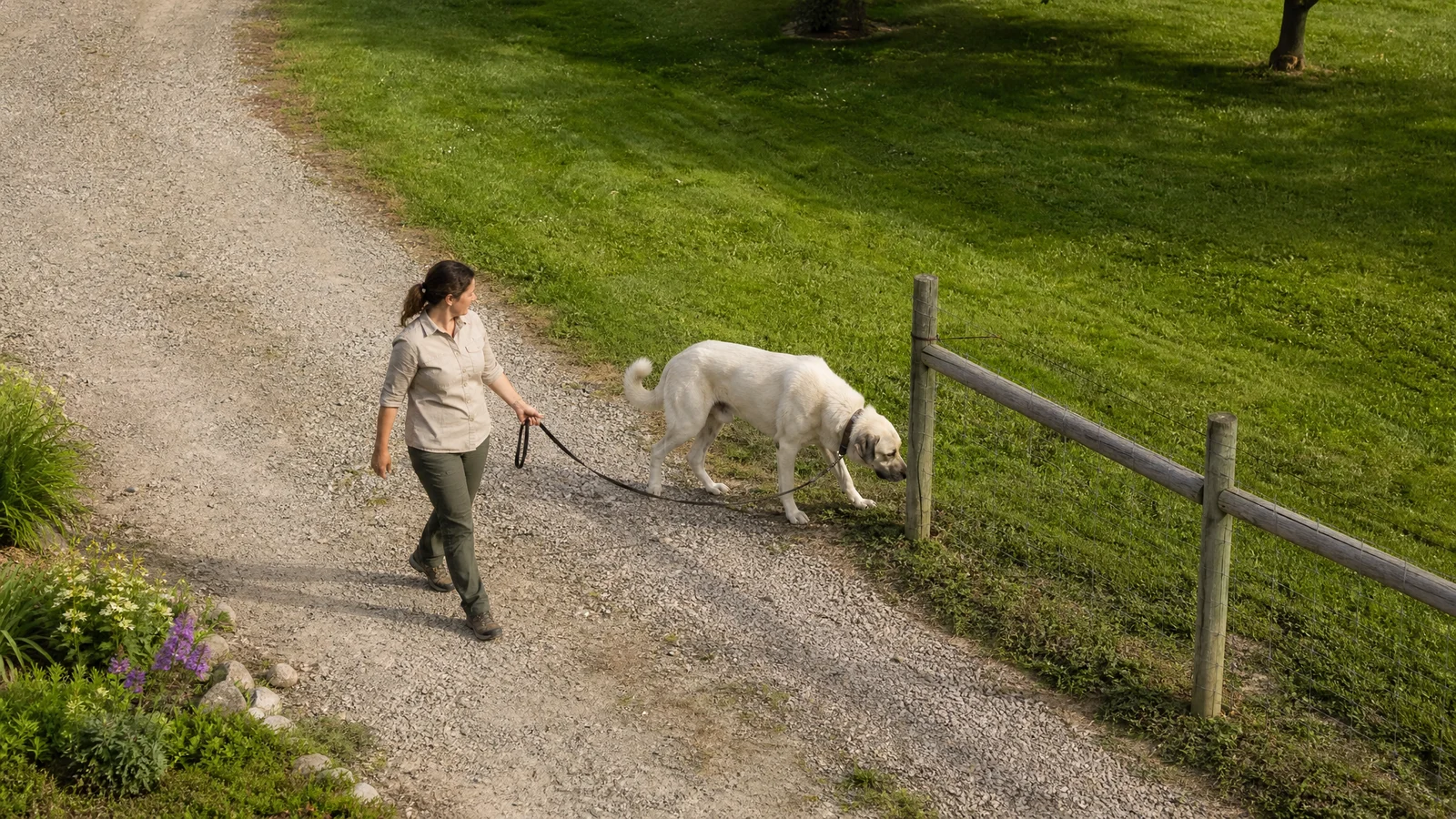
A loose leash comes from one rule: a slack leash moves you forward, and a tight one stops the walk. The picture to aim for is plain: the leash hangs in a loose curve, the dog stops to sniff a fence post, and you carry on at an ordinary pace.
The Anatolian Shepherd Dog Club of America notes that natural independence can make these dogs slower to respond to commands, so we expect to repeat that rule many times rather than settle it in a session or two. By the end of this guide, you should be able to hold the slack-leash rule on an ordinary walk, with your dog set up, fitted and rewarded for it, and the guide also points you to other help when the trouble is something other than pulling.
What a Loose Leash Means for an Anatolian Shepherd
A loose leash means the line has some give in it most of the time. It does not mean the dog walks silently glued to your knee or never investigates anything. PDSA encourages letting a dog sniff and explore on walks, since that is what dogs love doing, so a walk can include stops and detours and still count as loose.
The skill we are building is narrower than it sounds. The dog learns that tension ends forward progress and slack restores it, and everything else about the walk is allowed to stay ordinary.
Pulling itself is natural. The same source lists excitement, plenty of energy and a strong wish to explore as common reasons, and adds that for some dogs it is simply a habit, learned early, because pulling got them to go forward. That is why we work on what the leash does when it tightens and leave the dog's feelings about walks alone.
A Loose Leash Is Not a Heel
A heel asks for a precise spot beside you, usually with the dog's attention on your hand. A loose leash only asks that the line stay slack, wherever the dog happens to be walking, which makes it the more realistic goal for an everyday route.
If you later want a fixed position at your side, treat it as a separate skill. The Anatolian Shepherd obedience guide covers cue work for a dog who thinks for themselves.
What the Breed Brings to the Walk
The American Kennel Club rates Anatolian Shepherd trainability at Level 2 of 5, on a scale where 1 is Self-Willed, 3 is Agreeable and 5 is Eager to Please. It rates energy at Level 3 of 5, which it labels Moderate. On that scale, a Level 2 sits nearer the Self-Willed end than the Eager to Please end, while energy sits in the middle.
The same page calls obedience training a must for the breed, says the Anatolian was bred to work independently and make decisions on their own, and admits that training the breed to respond to commands can be a challenge, which is a fair warning for anyone who expects a quick fix.
None of this tells us how long your own dog will take, and no source gives a timeline. What the sources do tell us is to plan for plenty of repeats and to make every reward worth the dog's attention.
The Stop-and-Wait Rule for Anatolian Shepherd Pulling
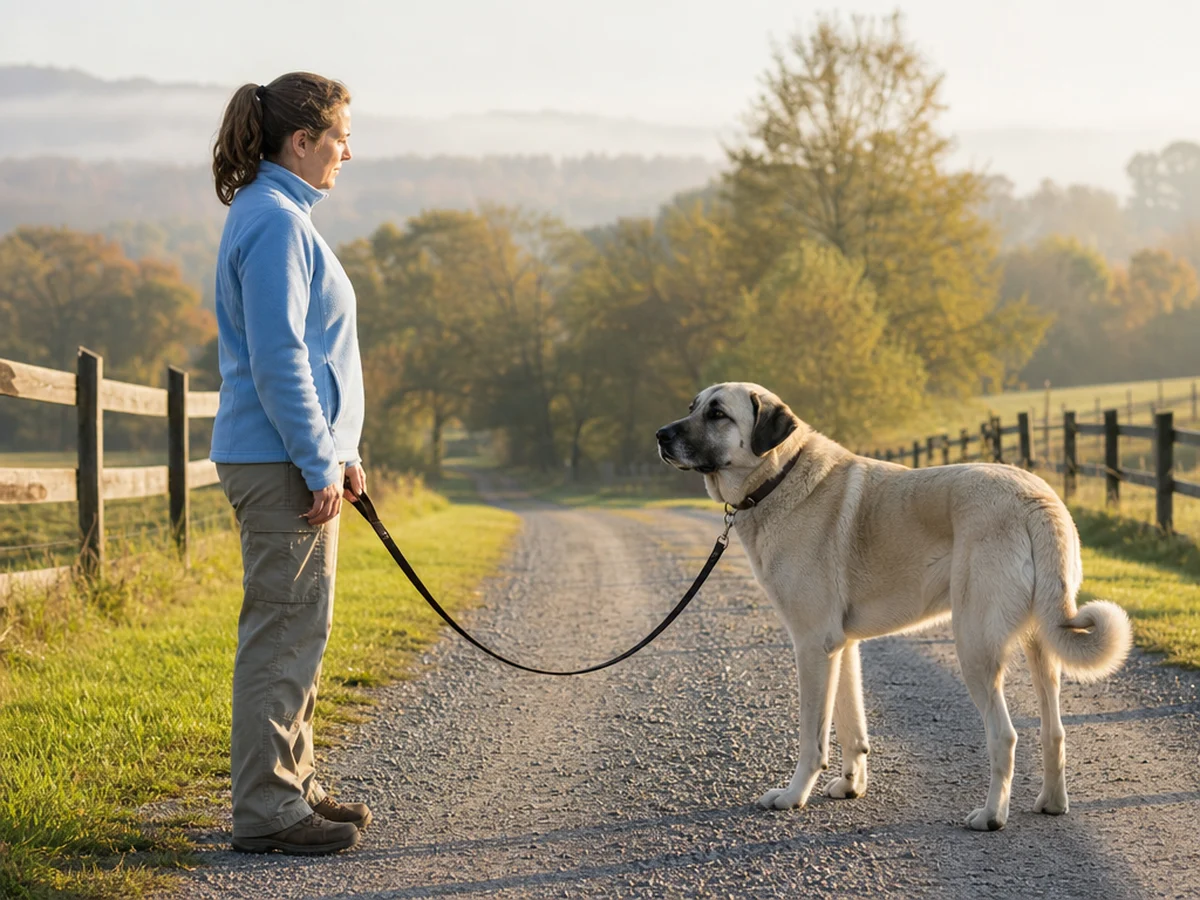
When the leash tightens, stop walking. Do not pull the leash back toward you and do not hurry the dog along. Stand still and wait for the tension to release. The moment slack returns, praise the dog, offer a treat and walk on, so that their own choice to ease off is what restarts the walk.
Best Friends Animal Society adds a second move for the dog who keeps leaning after you stop. Turn and walk the other way. The change of direction puts the dog behind you, and when they turn with you, praise and a treat pay for following. Never yank the leash as you turn.
Why Every Tight Moment Gets the Same Answer
Consistency carries more weight than any single technique. Stopping on four pulls out of five teaches the dog that pulling can still end in moving forward, because a dog reasons that if it worked once, it will probably work again. A dog with a long pulling habit may keep pushing forward for a while even after you have stopped, so build in that waiting time.
Everyone who holds the leash needs the same rule. A rule that holds on Saturday and lapses on Tuesday gives the dog a reason to try again on Tuesday.
Why Early Walks Go Slowly
Expect a walk to cover less ground at first. You may stop and start many, many times, and the same route can take much longer than usual. A short stretch with several clear successes is worth more than a long route walked on a tight leash.
PDSA calls teaching a dog not to pull a very long process that takes consistency and patience. That fits a breed described as slower to respond to commands, and it is a good reason to judge a walk by how many times slack won, not by the distance covered.
It will probably take many walks and plenty of treats before the pulling fades. Practice on every walk, including the short ones, and never tell the dog off for pulling, since a reward for the right behavior teaches faster than any complaint about the wrong one. The Anatolian Shepherd leash training guide carries the wider everyday skill once the tension is repaired.
Getting an Anatolian Shepherd Ready for Leash Practice
Practice goes better when the setup removes as much temptation as possible. None of it replaces the stop-and-wait rule, but each piece makes slack easier for the dog to find.
Begin where nothing competes with you: a home or yard works best at first, and a quiet area comes next, so the dog can focus on the leash and not on everything around them.
- When you first start training, give the dog a long play session beforehand if it is safe to do so, because it tires them out a little so they are less keen to pull.
- Carry treats the dog truly loves, and allow for them when you measure meals, since early practice can use quite a few. They do not need to be fattening: boiled chicken or turkey breast, or slices of carrot for a dog who loves the crunch, can all work.
- Check that the collar fits snugly, with room for a finger or two between the collar and the dog's neck.
- If the sight of the leash sends the dog into a frenzy, make it ordinary by leaving it out, picking it up and putting it down, or clipping it on briefly and taking it off.
The Anatolian Shepherd exercise guide has ideas for what that play can look like. Once slack comes easily at home, move the practice to a quiet street or park. Each new place is harder than the last, so expect to repeat the stop-and-wait rule more often when the setting changes. A few easy repeats in the new spot, close to where you started, are worth more than hurrying on to a longer route.
Gear for an Anatolian Shepherd Who Pulls
Equipment can make the first weeks more comfortable, but it does not teach the rule. Whatever the dog wears, the stop-and-wait response stays the same, and the choice comes down to fit, comfort and how much steering you need with a very large dog.
The table sums up what our sources say about the three options most owners consider. Treat each row as a starting point, because the dog's reaction to the gear counts for more than any rule of thumb.
| Option | What the sources say | Fitting note |
|---|---|---|
| Harness | Recommended for dogs who pull, to help protect the neck. A good one avoids pressure on the neck and allows free shoulder movement. | Try over-head, step-in and clip-around styles, and look for a Y-shaped front. |
| Head halter | Suits larger, stronger dogs because the leash attaches under the chin and lets you gently guide direction. | Needs a gradual introduction, covered in the section below. |
| Flat collar | A simple, safe choice for most dogs when it fits snugly. | Aim for a snug fit with a finger or two of room between the collar and the neck. |
Introducing Gear at the Dog's Pace
New equipment goes best when the dog sets the speed. Battersea Dogs & Cats Home suggests rewarding the dog for sniffing or approaching a harness and building up gradually. If a dog has already learned to pull hard in one harness, switching to a different style can help.
A dog who avoids their equipment altogether may be in pain, so talk to your vet, since regular check-ups are also the place to raise it. Signs of pain or fear mean pausing the practice until you have advice.
Most dogs tolerate a harness without much fuss. A head halter is stranger, and a dog wearing one for the first time will probably paw at it. Get moving, keep walking and hand over small treats with praise so the dog has something better to think about, and never jerk the leash. Whichever piece of gear you choose, take it off when the walk is over, because a dog left unsupervised in a halter or harness can catch it on something or chew through it.
Rewards That Keep an Anatolian Shepherd Walking Loose
Food is the quickest way to make slack worth choosing, but it is not the only reward. Praise, petting and attention all count. Reward the dog whenever they walk beside you or keep the leash loose near you, not only after a stop, so staying close becomes the place where good things happen.
Keep the treat quick so the walk keeps moving. Praise and a small treat the moment the tension is gone work better than a long pause, because the dog links the reward to the slack and not to the interruption.
Moving forward is a reward in its own right, and so is a good sniff. When the dog has kept slack for a few strides, let them stop at a scent before you walk on, so slack buys access to the things they care about.
Match the reward to what your dog loves. Favorite treats are what the early work needs, and a warm word or a few steps toward the scent can stand in for them when a treat is not at hand.
Changing Direction to Reset Attention
Many random changes of direction teach the dog to focus on you and move with you. Instead of walking in a straight line from point A to point B, move in unpredictable directions, then reward the dog who follows along.
Use it on a quiet route when you notice attention drifting. Keep the turns relaxed and the leash loose as you pivot, and let the reward arrive as the dog turns with you.
Fading Treats After an Anatolian Shepherd Stops Pulling
Once slack becomes the dog's default on quiet routes, you can start to thin out the treats. Replace some of them with plenty of praise, and do it gradually. Dropping treats all at once risks the dog losing motivation, so phase them out slowly.
Pulling is also not the only way a leash walk can go wrong. A dog who lunges, barks or fixes on people, dogs or animals has a different problem from tension on the leash, and it belongs in the Anatolian Shepherd leash reactivity guide rather than here. The Anatolian Shepherd behavior problems guide shows where other everyday behavior fits.
As the treats thin out, watch whether the leash stays loose. If praise on its own does not hold it, look for a healthy alternative the dog values and use it for as long as it works.
 Training basicsAre Anatolian Shepherds Easy to Train? Smart or Stubborn
 Puppy trainingAnatolian Shepherd at 6 to 12 Months: Adolescence Begins
 Puppy trainingAnatolian Shepherd Puppy at 8 to 12 Weeks: The First Month Home