
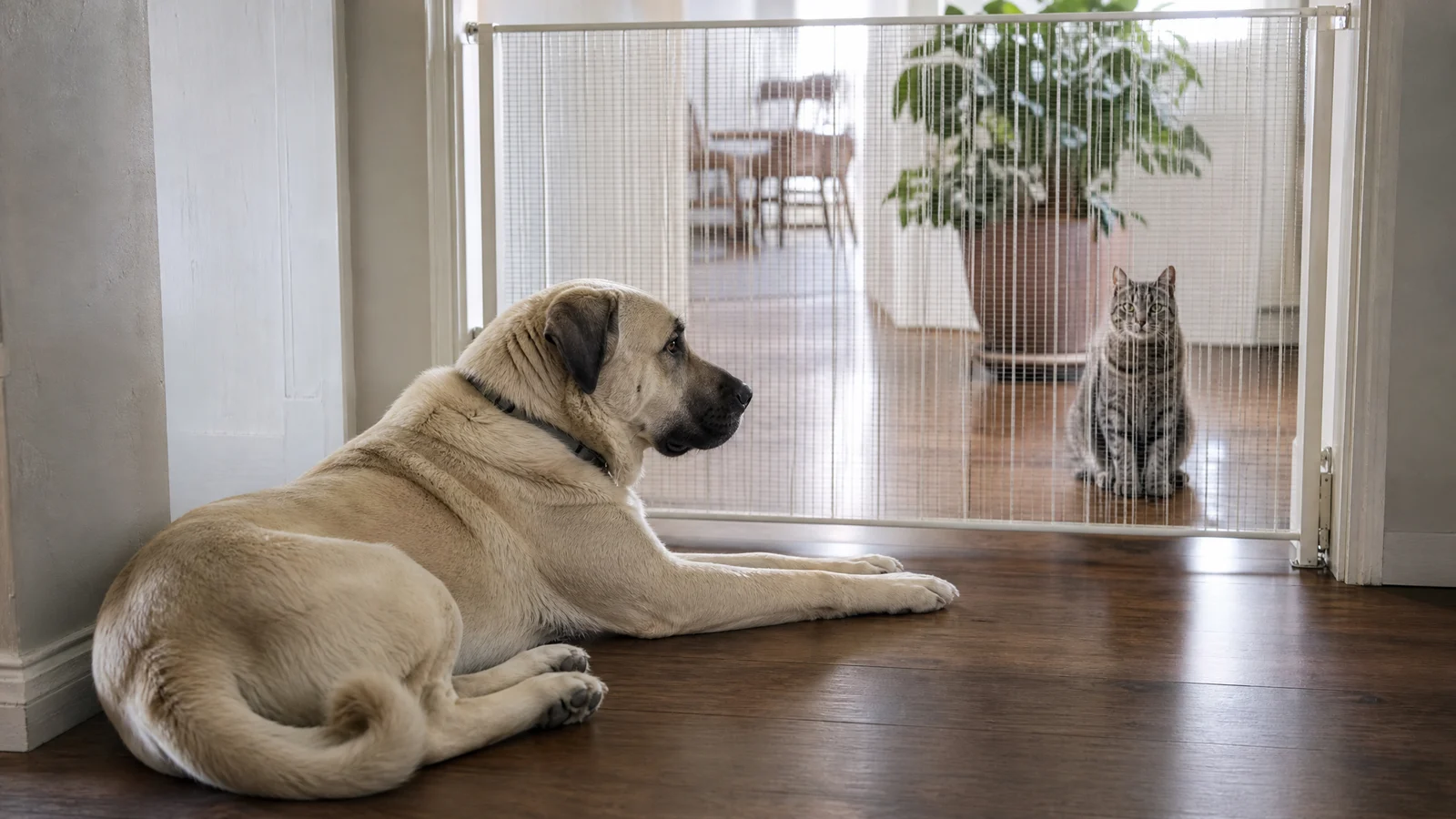
Sooner or later every mixed household has to settle the same practical questions: which animal gets which room, who is watching when they share one, and what happens when a first meeting goes badly. With an Anatolian Shepherd, those questions deserve answers before anyone is introduced, because supervision is the condition that the breed's own descriptions keep returning to.
No source can promise how a particular Anatolian will treat a cat or another dog, in either direction. So we plan around supervision and keep separate spaces open as a legitimate outcome, not a failed one.
Early mistakes between a dog and a cat are hard to undo, which is why the order of the steps matters. Read on for how the breed's ratings set expectations, how to prepare the home, the gate method for cats, neutral-ground meetings with other dogs, and the signs that mean it is time to stop and call for help.
Why Supervision Comes First With Anatolian Shepherds and Pets
The American Kennel Club rates the breed 3 of 5 for Good With Other Dogs, a score it labels With Supervision, and says dogs should always be supervised for introductions with other dogs. The breed description adds that an Anatolian will protect livestock, children, smaller dogs and even the family cat with intensity, and its note on other animals says to always supervise interactions between species.
Breed-club language points the same way. The Anatolian Shepherd Dog Club of America says Anatolians were bred for millennia to exercise independent judgment in response to perceived danger, and that these guardian dogs will protect. It also says they should never be allowed off leash off their property, with the possible exception of completely fenced spaces.
Both descriptions are about the breed, so neither predicts how one dog will behave around a cat. We treat supervision as the standing condition and the guardian history as background only, since nothing here asks a dog to guard or protect anything. For how that history plays out around stock, see our Anatolian Shepherd livestock guardian guide.
Setting Up the Home Before an Anatolian Shepherd Meets Pets
Most of the useful work happens before any greeting. The sources we draw on agree that each animal needs its own territory, its own resources and a route away from the other, and that time apart at the start belongs to the method.
A Zone for the Cat
Divide the home into a cat zone and a dog zone, and make the cat zone the area the cat already uses most. Changes to the cat's space should happen well before the dog arrives, ideally at least a week ahead, so the new routine already feels normal. In a small home that may mean giving the cat a whole room, with food, water, a litter tray, a bed and a scratching post all inside.
Make higher spaces such as shelves, cabinets and the tops of wardrobes available as retreats and escape routes. Baby gates can keep the dog out of stairs or rooms that belong to the cat. A second food and water bowl and a temporary extra litter tray in a different part of the home mean the cat never has to cross the dog's area to eat or use the box, and a cat who prefers the outdoors still needs safe access to it.
Bowls, Beds and Toys for a Second Dog
With two dogs, mealtimes and resting places are the usual friction points. Feed the dogs in different rooms and make sure whichever dog finishes first cannot reach the other's bowl, which keeps food guarding from developing. Each dog also needs somewhere to go to be alone, away from the other, so give each a bed in their own space, because beds side by side can be intense.
Put away the resident dog's most loved toys while introductions are under way, since they can come back later. Our Anatolian Shepherd food and space guide goes deeper on guarding of meals and resting spots, which is a separate topic from the introductions covered here.
Weeks Apart and Swapped Scents
Plan on keeping a new dog and a resident cat completely apart for at least two to three weeks before any careful introduction. A new dog takes about three weeks on average to settle into a new routine, so introductions should not be rushed after the first few days.
While the animals are apart, swap blankets between the cat and the dog each day so each can learn the other's scent without pressure. On the day the dog arrives, shut the cat in its safe space before you leave to collect them, so the cat is not waiting just inside the front door. A cat and dog relationship has a hard time recovering from a bad early encounter, and early exposure for a young Anatolian is covered in our Anatolian Shepherd socialization guide.
Introducing an Anatolian Shepherd to a Cat Through a Gate
Battersea Dogs & Cats Home advises that first greetings always happen with the dog on a leash and ideally behind a barrier such as a baby gate. The cat needs escape routes it can reach quickly and safely, and Battersea recommends that a responsible adult supervise every dog and cat interaction, no matter how positive the relationship looks.
Marking Calm Looks and Adding Distance
Set up with the dog on a leash on one side of the gate and the cat on the other, ideally after the cat has chosen to rest somewhere outside its safe space. Never force the cat into the situation. Have high-value treats ready, and know that a long-lasting chew can help the dog stay occupied while the cat appears.
The moment the dog notices the cat, calmly mark the look with a consistent word such as yes or good and offer a treat. Watch the response, because the dog may stay calm, or may whine, bark, seem excited or abandon the chew. If the dog is alert and fixated, call their attention to you and move further from the gate to a distance where calm returns, then reward.
At first the dog looks at the cat only briefly before the mark and the reward, and the time builds slowly at the pace of both animals. If the dog cannot look away, a treat held under their nose can guide their attention to you. Later, wait quietly and see whether they look back on their own, which deserves heavy praise and a treat.
Taking Off the Leash, Then the Gate
Only when the dog reliably looks away from the cat and back to you can the leash come off, with the gate staying in place. Read the rest of their body language first, because a dog can look back for a treat while still on high alert. Until the dog is truly relaxed, keep a leash on, and a long line is a middle ground that keeps control without grabbing at a collar.
Getting to this stage can take days, weeks or months depending on the dog, so it should never be rushed. Once the dog stays calm off leash with the cat visible through the gate, the gate can go, but the first face-to-face greeting happens on a leash. Repeat the marking and rewarding, and expect to go back a step, because the dog may stay calm only briefly at first.
Anatolian Shepherd Dog Introductions Start on Neutral Ground
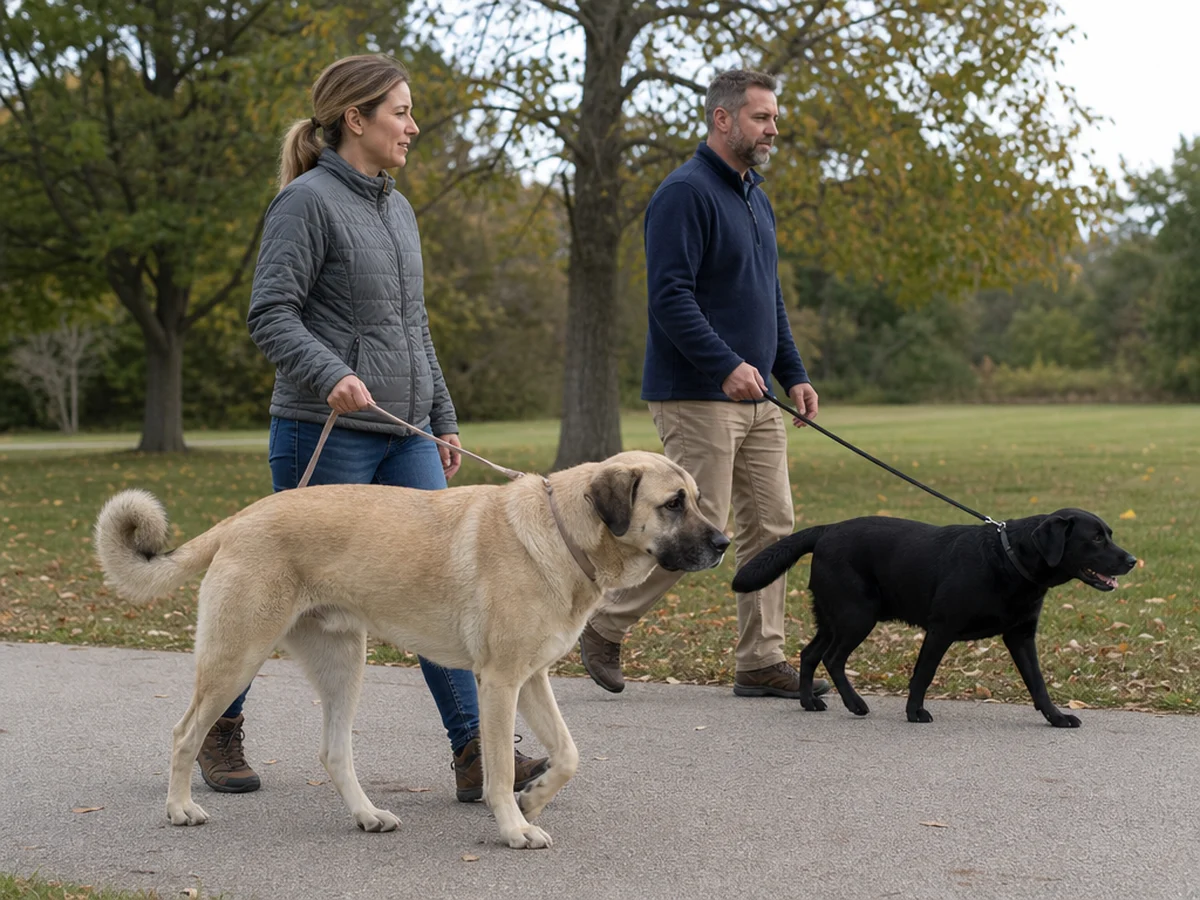
The PDSA recommends that two dogs meet first on neutral territory, such as a quiet park neither has visited, with both on leash and a second person helping. The dogs walk within sight of each other at a good distance while the handlers watch for stress or aggression, and the meeting stops if either dog looks likely to become aggressive.
When both dogs are comfortable, they can meet face to face on fairly loose leashes, since a tense handler can make dogs think there is something to worry about. Let them say hello slowly, praise both and separate them if things turn aggressive. Then walk them together on leash for a few walks, without forcing them to interact.
Off-leash play comes only after several walks where both dogs are pleased to see each other, in a secure area neither sees as theirs. For an Anatolian, that means a completely fenced space, which our Anatolian Shepherd fencing guide covers. Skip toys at first, and if play gets too rough, call them back, praise them and let play resume. Our Anatolian Shepherd recall guide teaches that cue.
Meeting at home comes last. Because the visitor is entering the resident dog's space, both dogs go back on loose leashes, and the leashes come off only under close supervision once both seem comfortable. Matching counts too, since a second dog may not suit a dog who dislikes other dogs, and an excitable puppy in a calm dog's face can cause tension.
Reading Tension Between an Anatolian Shepherd and Other Pets
The ASPCA notes that dogs rarely bite without some warning, even if the warning comes only milliseconds before the bite. That is a narrow window, so it pays to learn what tension between two animals looks like well before a meeting gets close to the edge.
Battersea's body-language guidance for dogs separates play from pressure. A playful dog is more animated, may bow with the front end lowered and the rear in the air, or may jump around excitedly, which are signs that the dog actively wants to play.
Pressure looks different. Tension around the face, a tail held down between the legs and one front paw lifted while standing are the dog's way of asking for the situation to stop. An uncomfortable dog can also look much like a relaxed one, so context counts and so does knowing what is normal for this particular dog.
Break Signs From Either Animal
Battersea's advice for a puppy and cat whose first meeting does not go smoothly lists signs of stress such as growling, hissing, barking or stalking, and says any of them means it is time to take a break. The list does not sort the signs by species, so we watch both animals for all of them. The advice was written for a puppy, and we apply the same pause to any pairing in this guide.
Hissing and stalking also lead back to the cat's exits. The gate steps say twice that the cat must have escape routes and be able to remove itself quickly and safely from anything uncomfortable, so check before every session that the high perch or doorway is still clear.
Pausing a Meeting and Starting Over
When a meeting does go badly, the first instruction is not to force more contact. Separate the animals safely and give both space to calm down, with a barrier such as a baby gate or crate setup so they can still see and smell each other without full access.
Then rebuild slowly with short, positive sessions of treats, praise and calm behavior, and keep later introductions controlled. Do not punish either pet, because punishment can simply create fear. Focus on calm reinforcement instead.
When a Pair Keeps Struggling
If concerns about the dog's behavior around the cat remain after several weeks of practicing the gate steps, or tension continues after a bad first meeting, the advice is to seek a qualified canine behaviorist. A professional who visits the home and sees the behavior first-hand can identify where training should be tailored to your situation.
Battersea's separate page on finding a trainer or behaviorist explains the split. Trainers teach skills such as sit, stay, recall and loose-leash walking, while behaviorists analyze and work to change problem behaviors such as aggression. Qualified behaviorists should work on veterinary referrals, so the vet comes first, and a vet check rules out any medical reason for the behavior.
The vet may solve the problem without a behaviorist, or recommend one they have worked with. Beyond referrals, we treat regular vet check-ups as part of keeping any dog well, and a sudden change in behavior as a reason to call the clinic.
Our Anatolian Shepherd trainer guide covers what to look for in a trainer in more depth. For a pair that is struggling, three questions are worth asking before you commit to anyone.
- What their experience, background and qualifications are.
- Which training techniques they use, since only positive, reward-based methods are advised and punishment can reduce confidence and cause fear-based aggression.
- What the cost includes, such as a written behavioral report, a training plan with clear goals and email or phone support.
Long-Term Arrangements for an Anatolian Shepherd and Pets
The careful process in this guide can end in two good places. In one, the Anatolian Shepherd and the cat or other dog share rooms and a daily rhythm. In the other, they share a house and never share a room. Both are sound outcomes, and neither says anything bad about the dog or about the person who did the work.
What the slow steps give a household is an honest answer about which of the two fits it, and then a home that can be lived in well with that answer. A household that reaches either one has done the job the introductions were meant to do.
 Training basicsHow to Teach an Anatolian Shepherd to Sit
 Puppy trainingAnatolian Shepherd Puppy at 4 to 6 Months: What Changes
 Exercise and jobsIndoor Activities and Brain Games for an Anatolian Shepherd